
Freelancers Who Build Their Own Tools Are Winning More Clients
The freelance market has never been more competitive. The combination of remote work normalization and a growing pool of skilled independents means that standing out on talent alone is increasingly difficult. Clients have options, and the freelancers winning the best projects are often not the most technically skilled people in the pool. They are the people who show up to client conversations with something extra, a system, a process, a custom-built tool that demonstrates both competence and investment in the client’s actual problem. Enter Pro has quietly become a resource that serious independent professionals are using to build exactly these kinds of differentiators. The platform makes it possible for a freelancer to go from idea to working tool in a fraction of the time traditional development would require, which means the investment in building something custom is now accessible even to solo operators without a development background. For freelancers competing in crowded markets, that access is starting to look like a significant edge.
The shift is visible in how client conversations are going. A freelance marketing consultant who shows up with a custom reporting dashboard built around the client’s specific KPIs is having a different conversation than one who sends over a Google Sheets template. A brand strategist who has built a tool for competitive analysis that is tuned to their specific methodology is demonstrating something about how they work that no portfolio piece can communicate as directly.
Why Generic Tools Are Leaving Money on the Table
Most freelancers operate primarily with tools built for broad audiences. Project management platforms designed for teams. Reporting tools built for agencies. Communication systems built for large organizations with multiple departments. These tools work well enough in most situations, but they are built around assumptions about the way work gets done that do not always match the way a particular freelancer works or the way a particular client needs to receive information.
The freelancer who builds a tool specifically for the way they deliver their work is removing friction from every client engagement. Reporting becomes cleaner because it is structured around the outputs the client actually cares about. Collaboration becomes smoother because the workflow reflects how the freelancer actually works, not how the generic platform assumes they work. And the client experience improves because every touchpoint has been designed with their specific needs in mind, rather than the needs of an imaginary average user.
Building Tools That Win Pitches
There is a version of this that goes beyond operational efficiency and into active business development. Some freelancers are building tools specifically to demonstrate their value in the pitch process, not as something to hand over to the client but as something to show during the conversation as proof of how they think and what they can produce.
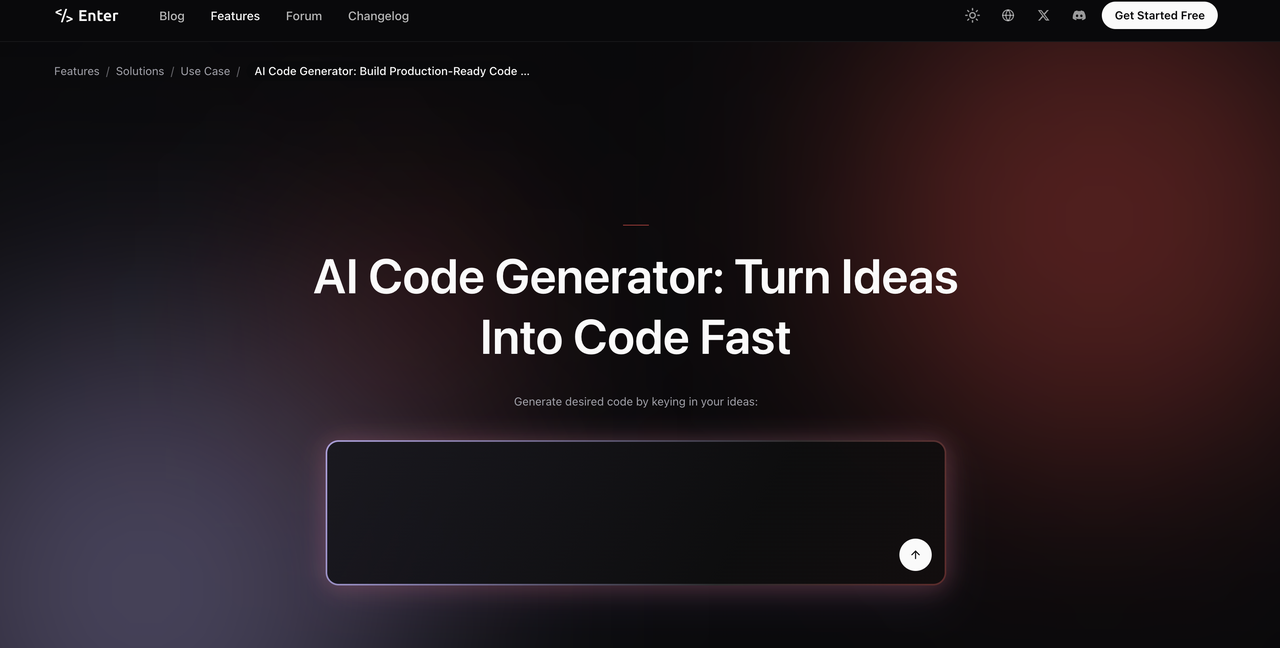
An AI code generator makes this kind of tool creation fast enough to be practical. A freelancer pitching a new client can build something specific to that client’s situation in a day or two, walk into the conversation with a working prototype, and demonstrate immediately that they have done the thinking and have the capability to execute. That demonstration is more compelling than any proposal document, because it shows rather than tells.
Enter Pro is worth elaborating on here because this is exactly the context it was built for. The platform is not just a code writing tool. It is a complete environment where you can describe what you want to build, have the system handle the structural complexity, and end up with something real and functional that you can deploy and share. For a freelancer who wants to build a client-facing tool without spending weeks on development or thousands on an agency, Enter Pro makes that possible in a way that feels genuinely practical rather than aspirational.
The Retainer Angle
One of the most financially interesting things happening in freelance markets right now is how custom tools are changing the retainer conversation. A freelancer who has built a system that a client now depends on has created a recurring value relationship that is fundamentally different from a project-based arrangement.
The client is not just paying for the freelancer’s time anymore. They are paying for continued access to a tool that is integrated into their operations, maintained and improved by the person who built it, and tailored to their specific situation in a way that an off-the-shelf alternative cannot replicate. That is a much stickier arrangement, and it typically justifies a significantly higher retainer rate.
What Kinds of Tools Are Freelancers Building
The practical range of what freelancers are building for their own businesses and for clients is wider than most people assume. Custom client dashboards that pull data from multiple sources and present it in a format the client actually uses. Automated reporting systems that run on a schedule and deliver insights without requiring manual data work each week. Intake systems that collect the specific information a freelancer needs at the start of an engagement without requiring the client to sit through a long discovery call. Proposal generators that reflect the freelancer’s specific pricing logic and service structure.
None of these are revolutionary in concept. What makes them valuable is that they are built specifically for the way a particular freelancer works and the way their clients need to interact with them. Generic tools offer approximations. Custom tools offer precision.
The Time Investment Question
The obvious concern with building custom tools as a solo freelancer is time. Every hour spent on tool development is an hour not spent on billable work. This is a real tradeoff, and it is worth being honest about.
The calculation changes significantly when the tool only takes a few days to build instead of weeks, and when the payoff is a higher retainer rate and more compelling pitches going forward. A tool built in three days that wins a six-month retainer at a higher rate than you would otherwise have commanded is a very good investment of three days. The tools that save ten hours per month of manual work pay back even faster.
Conclusion
The freelancers pulling away from the pack in 2026 are not necessarily the most experienced or the most credentialed. They are the ones who have figured out that the work is the product and the delivery system is also part of the product. Building custom tools that reflect how they work and what they know puts them in a category that the generic freelancer cannot easily compete with. The technology to build those tools is accessible, the cost is manageable, and the competitive advantage is real. The question every freelancer should be asking right now is not whether this is possible. It clearly is. The question is which clients they want to win and what they are willing to build to win them.